BlogGuides
What is a cut list? How to read one and send it to a cutting service
A cut list turns a design into panels you can cut. What it contains, how finished sizes, saw kerf and grain direction work, and how to send one to a panel-cutting service.
 Illustration
A design is a picture. A cut list is the recipe: every panel you need, at its exact size, ready to cut. Whether you cut the panels yourself or send them to a timber yard, the cut list is the document that decides whether the piece goes together.
What is in a cut list
Here is the cut list for a simple oak bookshelf, 900 mm wide and 1,800 mm high:
| Part | Name | Qty | Length × width × thickness | Material |
|---|---|---|---|---|
| P1 | Side | 2 | 1,800 × 294 × 18 mm | Oak-veneered plywood |
| P2 | Shelf | 3 | 864 × 293 × 24 mm | Oak-veneered plywood |
| P3 | Bottom | 1 | 864 × 293 × 18 mm | Oak-veneered plywood |
| P4 | Top | 1 | 864 × 293 × 18 mm | Oak-veneered plywood |
| P5 | Back | 1 | 1,800 × 900 × 7 mm | Oak-veneered plywood |
Each row is one kind of panel:
- Part number: the label that follows the panel through the build. It should match the drawings and the assembly guide.
- Quantity: identical panels share a row.
- Length, width and thickness: by convention, length runs along the grain.
- Material: the sheet it comes from. Mixed materials are best grouped separately, because they come from different sheets.
Finished size or cut size?
Most cut lists give finished sizes: the size the panel ends up. Two things can make the size you cut different:
- The saw cut. Every cut turns a strip of wood into dust, the kerf, usually 2 to 4 mm wide (about ⅛ in). Measure each panel from a fresh, straight edge rather than marking several panels in a row with one tape measurement.
- Edging. If a panel gets 1 or 2 mm edge banding, it may need to be cut smaller by that amount. Ask your cutting service whether their edging is included in the size you order.
Grain direction
On veneered plywood and real wood, the grain should run the long way on sides and doors and across the width on shelves, so a piece looks continuous. On a cut list, length is the grain direction, so a 1,800 × 294 mm side has its grain running up the full height.
Sheets and how many to buy
Panels are cut from standard sheets. In the UK and the US the common size is 2,440 × 1,220 mm (8 × 4 ft). In mainland Europe, 2,500 × 1,250 mm and 2,800 × 2,070 mm are common.
Fitting the panels onto sheets with as little waste as possible is called nesting, and it decides how many sheets you buy. Most panel-cutting services do it for you from the cut list. Caminu’s cut lists don’t lay panels out on sheets yet: they tell you exactly what to cut.
Drilling sheets
Holes are the second half of the recipe. A drilling sheet gives each hole’s position measured from a marked edge, its diameter and its depth, face by face. With it, nothing is left to work out at the bench, and a service with a CNC machine can drill the panels as well as cut them.
Sending it to a cutting service
- Export the list as a spreadsheet. Most services accept CSV or Excel.
- Check the material and thickness against what they stock.
- Say which edges get banding, and in what.
- Ask them to label each panel with its part number.
- Check the sizes on delivery before you start building.
Label every part
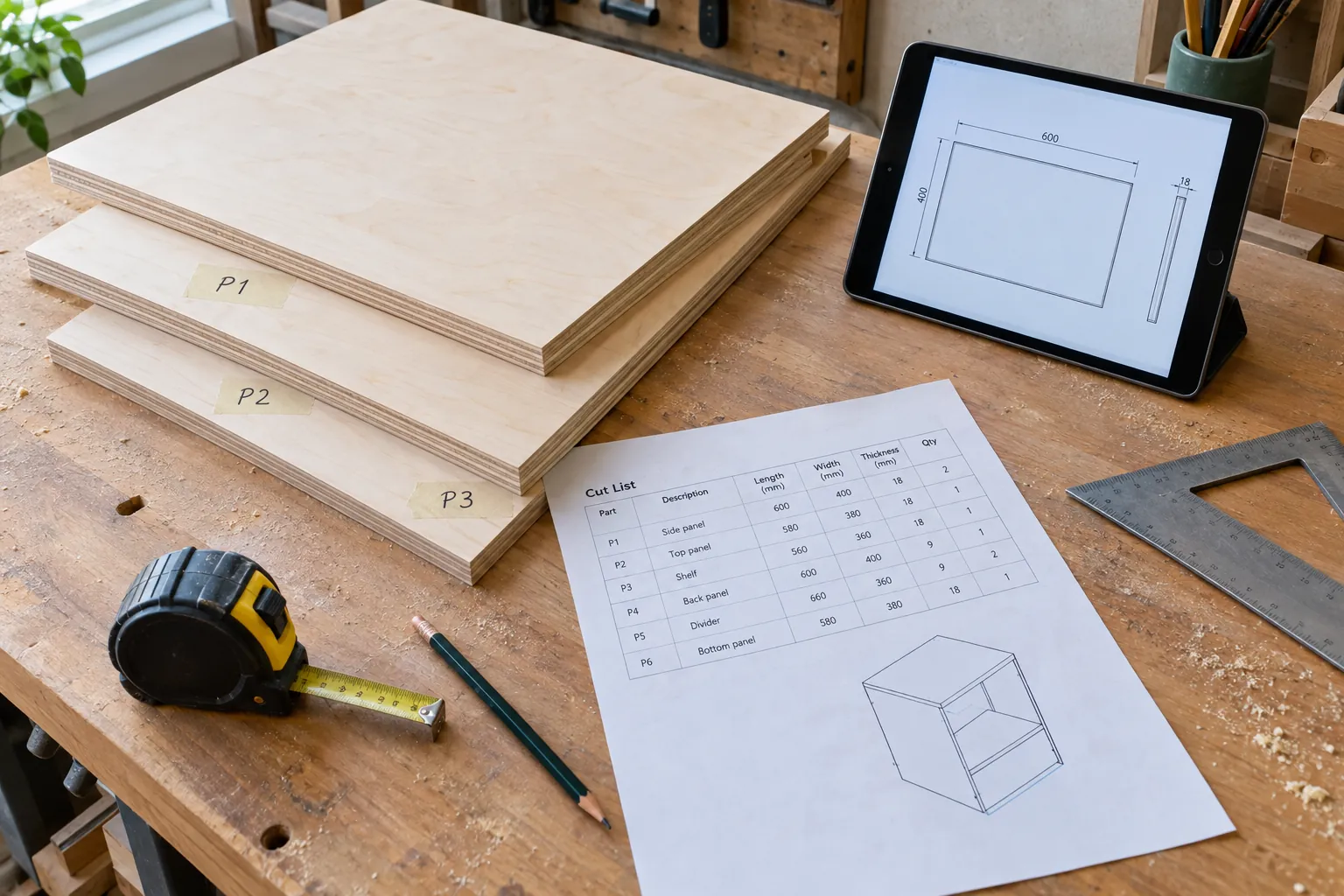
Whoever cuts the panels, write each part number on a strip of masking tape as soon as the panel is cut. When the assembly guide says “join P3 to P1”, you will want to find them in seconds.
Get a cut list from a design
In Caminu, the cut list comes from the 3D model, so a change to the design, 40 mm narrower or an extra shelf, updates the panels and the holes with it. See how cut lists work in Caminu.